
Marketing Experiment Log: A Simple Way to Test Ideas Without Guesswork
A good test helps you make one choice. Set a goal, track one main result, and write down what you learn, even when the test fails.
A good experiment starts with one decision
Many teams run a campaign, look at a dashboard, and call the result a test. Yet a number has little value if no one knows what decision it should change. A useful marketing experiment starts with a plain question: what will we do if this works, and what will we do if it does not?
Imagine a small online course business. Its team has a page that gets visits but few lesson enquiries. One person wants a new headline. Another wants new photos. A third wants to buy more ads. Testing all three at once may produce a better result, but it will not show which change mattered. Start with one change that can help the next decision.
This guide shows how to keep a simple marketing experiment log, from the first question to a fair review. It works for a website, email list, social campaign, or paid ad. You can use a spreadsheet, a shared note, or a project board. The tool matters less than the questions you record.
Write the problem before the idea
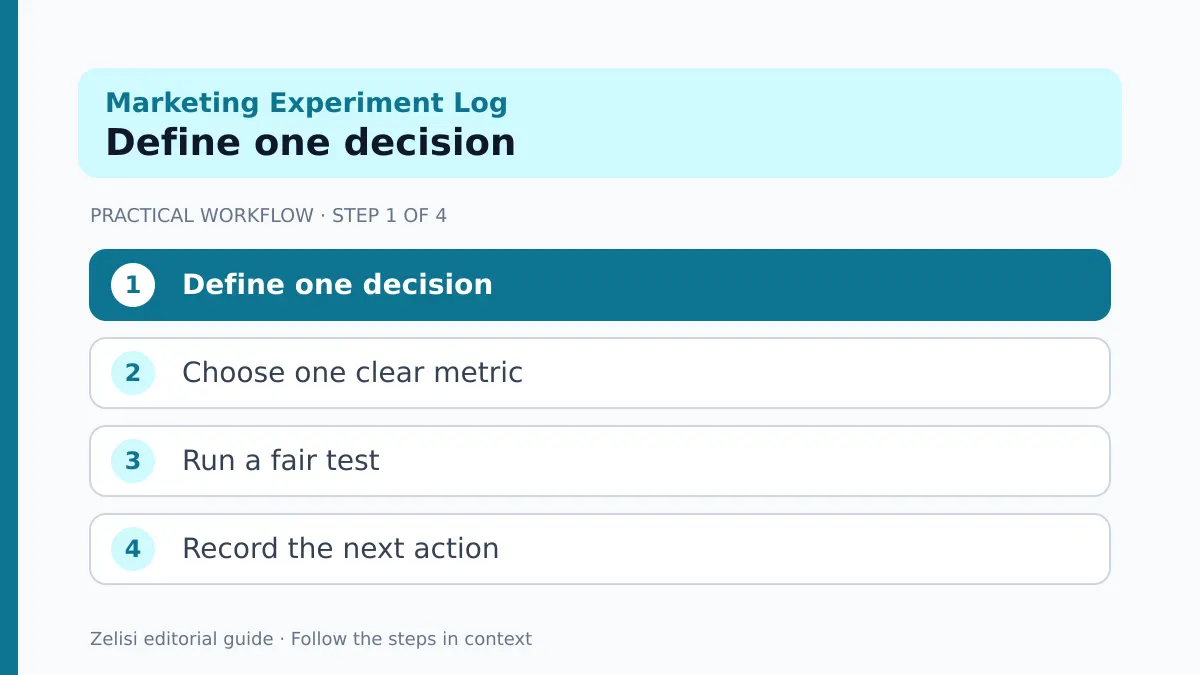
Start with what people do today. Do not start with a guess about why they do it. A useful problem statement might be: “Visitors read the course page, but few open the lesson outline.” That is an observation. “They hate the design” is a theory.
Next, name the reader you hope to help. The course team may serve adults who study after work. Those people need to know how much time each lesson takes. The team can test whether showing that detail near the top helps visitors find a useful answer.
If you do not have enough data to see a pattern, start with a small qualitative check. Ask people to find one piece of information on the page and note where they hesitate. Do not treat five informal conversations as a survey of the world. They can still reveal a problem worth testing.
A test should address a real choice. If both possible results lead to the same action, it may be a report, not an experiment.
Choose a measure that matches the goal
A business goal can be broad, such as gaining more qualified enquiries. A test measure needs to be narrow enough to observe. For a lesson outline test, the primary measure might be the share of eligible page visitors who open the outline. A second measure could be the share who submit an enquiry.
Avoid picking ten winners after the test ends. Choose the main measure before you start. Keep supporting measures as guardrails. A new headline might increase clicks while reducing completed forms. Both facts matter.
In Google Analytics 4, a key event marks an action the business sees as important. Check that the action fires as expected before you use it to judge a test. The help center also explains how the action appears in reports. A broken event can make a good page look weak.
If a result will affect money, check the amount at stake. A tiny change on a page with ten visits is not the same as a change on a busy checkout flow.
Record a test card that anyone can read

A real-world workflow
An experiment log should let another teammate understand the work without a meeting. Give the test a short name, an owner, a start date, a clear change, a primary measure, and a stop rule. Add a link to the page or campaign and a note about who can see the new version.
For a course page, the card might say: “Show lesson time beside each module title.” Its expected effect is that visitors can judge the time they need with less effort. The main measure is lesson-outline opens per eligible visitor. The guardrail is completed enquiries. The team decides in advance when it will review the result.
Do not hide uncertainty. If two campaigns run at the same time, note them. If the site had an outage, write that down. If traffic came from a large one-day promotion, include it. These details are part of the evidence, not an excuse.
The log is most useful when it captures failed tests too. Otherwise the team may repeat the same idea six months later because no one can find the first attempt.
Keep the groups fair
An A/B test compares two versions when eligible people are placed into groups by a fair method. It is more reliable when both groups run during the same period and face similar conditions. Showing version A on Monday and version B on Friday may confuse the effect of a change with the effect of the day.
If you cannot split visitors, use a careful before-and-after check and call it that. Record the limits. A seasonal sale, a search ranking shift, or a change in referral traffic may explain part of the result. You can still learn from the check, but the claim should match the method.
Do not switch the main goal halfway through because a different metric looks good. You can explore other signals after the test, then label them as ideas for new work. Keep the original question intact.
Privacy also matters. Use data you have a sound reason to collect. A marketing test does not require saving personal details that the team will never use.
Give the test enough time
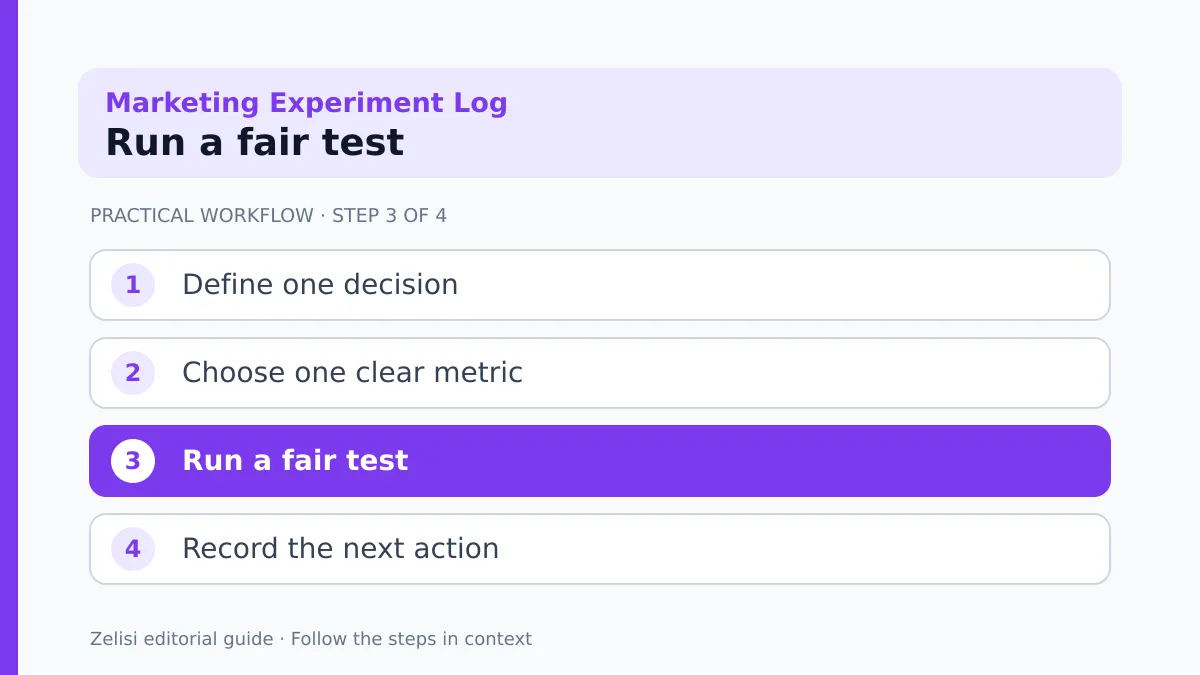
It is tempting to stop as soon as one version leads. Early results can swing with a handful of visits. Decide on a sensible review window and sample needs before launch, based on traffic and the size of change that would matter to the business.
A low-traffic site may need more time than a busy one. Do not invent a universal number of days. If the sample is too small, the honest result is “not enough evidence yet.” That answer can still save the team from a costly change.
Watch for faults while the test runs. Are both versions loading? Are mobile visitors seeing the right content? Does the key event fire once per action rather than twice? These checks protect the result without letting the team pick a winner early.
For an email test, check that send times, audience groups, and deliverability are comparable. A subject line test is hard to interpret if one group gets a message during a local holiday and the other does not.
Read the result as a decision, not a score
At review time, compare the pre-set main measure, guardrails, and quality of the data. Write the result in ordinary language. “More people opened the outline, while enquiries stayed similar” is easier to act on than a page of chart labels.
Ask what the team should do now. Keep the change, reject it, run a larger test, or ask users a new question. State the reason. If the data is weak, do not dress it up as proof.
The Google Analytics attribution guidance explains that channels may receive credit for key actions in different ways. This is a reminder to keep a test’s outcome tied to what it measured. A campaign’s reported credit is not the same as proving that a design change caused every sale.
If you change a page based on a test, watch it after rollout. A result from one audience or season may not carry over to all visitors.
A practical example: a small service business
A real-world workflow
A repair company receives many calls asking about appointment times. Its booking page has the answer, but the hours sit below a long introduction. The owner thinks a clear hours panel might cut repeat questions and help people book.
The team writes a test card. The change is a panel near the top with available service hours and a link to the booking form. The main measure is booking starts per eligible visit. A guardrail is form completion. Staff also record whether callers still ask about hours.
Before launch, the team checks the panel on phones and tests the form. It runs both page versions during the same period where possible. At review, it sees that visitors found the booking page more often, but form completion did not improve. The team does not claim more sales. It keeps the useful hours text and starts a new check on the form itself.
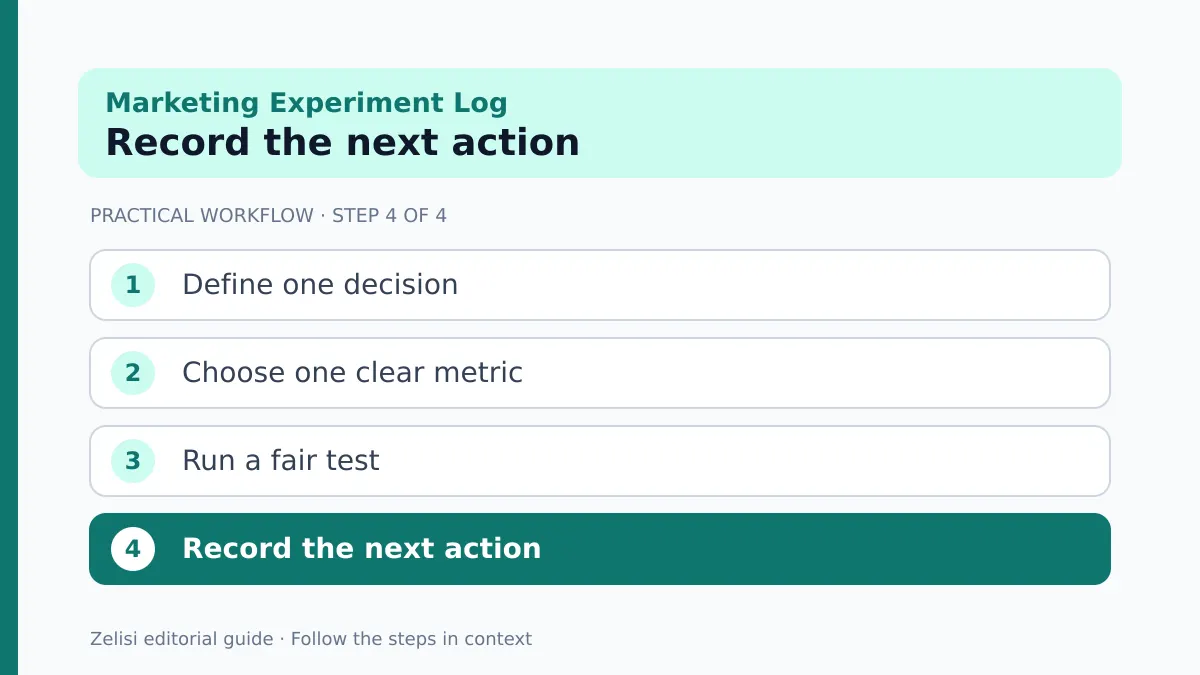
This is a valuable outcome because the business learned which problem it had solved and which one remains. A good experiment log turns a vague win into a clear next step.
A one-page template for your next test
Use a short record that fits your team. The goal is to make the work easy to repeat and easy to audit later.
- Question: What user problem or business choice are we testing?
- Evidence: What have we seen, and where did it come from?
- Change: What one thing will be different?
- Audience: Who is eligible to see the test?
- Main measure: What action will tell us most?
- Guardrail: What must not get worse?
- Method and dates: How will the versions be compared?
- Decision: What will we do with each possible outcome?
After the review, add the result, limits, and next action. Keep a link to the creative work and dashboard, but include a short plain summary too. Reports change and links can break. A written note keeps the learning alive.
If several people own marketing, agree on one place to store the cards. A shared log keeps the next campaign from starting with an empty memory.
Mistakes that make a test hard to trust
The first mistake is changing the headline, offer, audience, and landing page all at once. That may be a campaign launch, but it gives little insight into the role of each change. Another is choosing a measure because it is easy to see, even when it does not reflect the goal.
A common trap is celebrating a percentage without checking the base. A rise from one action to two is a 100 percent increase, yet it tells little about what may happen next month. Show the actual counts as well as the rates.
Teams also forget to record outside events. A media mention, holiday, or site outage may alter who visits the page. A brief note can prevent a false lesson. Finally, do not erase a weak result. A test that shows no clear difference may be the most useful reason to stop debating a low-impact idea.
Make experimentation a normal habit
Pick one meaningful question each month if your team is small. Meet for ten minutes to agree on the goal, review the test card, and confirm that the data works. A short process that people follow is better than a complex plan that stays in a folder.
Share the result with the people who answer customer questions. They may tell you why a change helped or why it confused visitors. Use that input for the next test, while being clear about the difference between feedback and measured effects.
Over time, the log becomes a record of what your audience needs. It can stop repeated debates, reveal weak assumptions, and guide better work. The aim is not to win every test. It is to make the next decision with a little more care and a little less guesswork.