
Writing Content for a Global Audience: A Practical Localization Checklist
The same article may not work well for readers in every place. Check the words, units, examples, and local rules so the advice stays useful.
Start with the reader’s task
A global article should help readers who live in different places. That does not mean each page must mention every country. It means the core advice should travel well and the text should make clear when a local rule or tool changes the answer.
A guide to planning a weekly meal can work across many regions. A guide to filing business tax forms cannot use one country’s rules as if they apply worldwide. The editorial task is to spot these limits before writing a headline that promises too much.
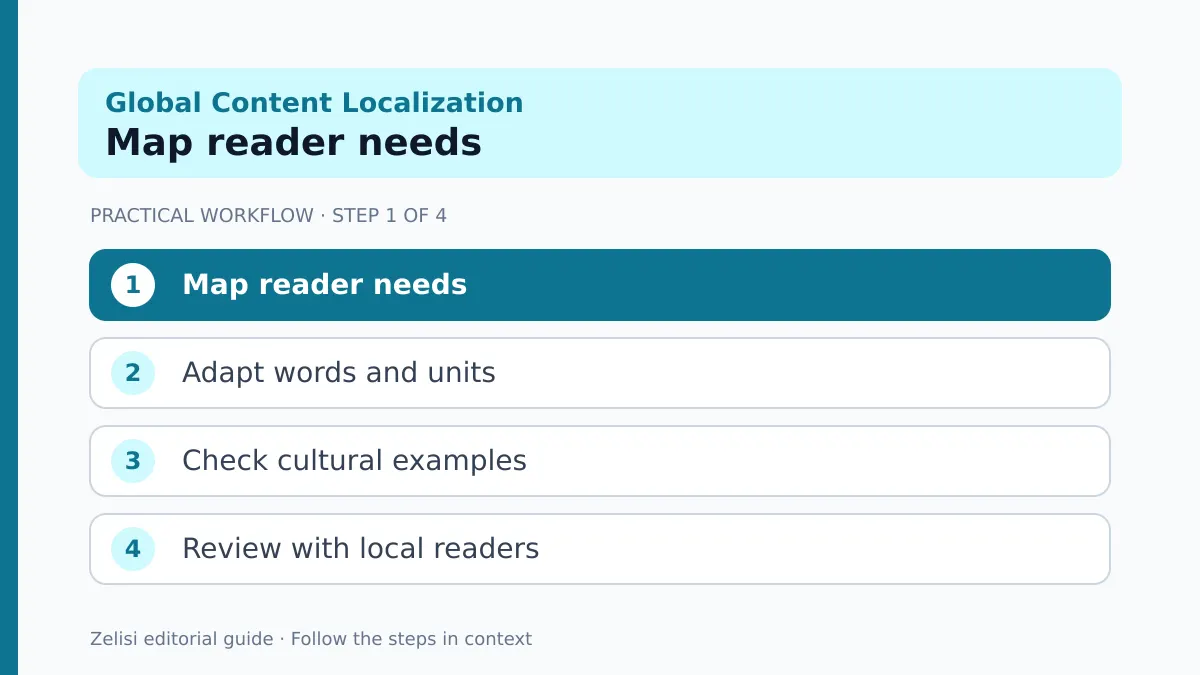
Start with the problem a reader wants to solve. Then ask which parts are universal and which depend on place, language, currency, season, or access to a service. That map helps you build useful content without filling it with vague notes about the world.
Mark local assumptions in the draft
Read the article and highlight every named law, currency, measurement, school term, public holiday, product price, and service availability claim. Also check examples that assume a particular type of home, job, or payment method.
A sentence such as “open a 401(k)” is useful to some readers but not all. A global guide can discuss workplace retirement plans in general and explain that local account names and tax rules vary. It should not give specific financial advice without suitable context.
Look at the screenshots too. A button label may differ by language or app version. A store may show a country-specific plan. Tell readers which version the steps refer to.
This check does not require removing all local examples. Keep one when it is useful, but label it clearly and offer a way to adapt the method.
Use clear words before translation
Questions for the editorial review
A text full of local jokes and idioms is harder to translate well. Replace a phrase like “hit it out of the park” with the actual result you mean. Simple English is also easier for readers who use English as a second language.
Write short sentences for key steps. Keep terms consistent across the page. If you call a feature “account settings” in the opening, do not rename it “profile controls” three paragraphs later without a reason.
The W3C explains the difference between making content ready for localization and adapting it for a specific locale. A clean source draft makes later work easier, but it is not the finished translation.
Do not strip the writing of personality. A warm example or a clear story can still feel human while avoiding phrases that only one group understands.
Choose examples that teach a method

A strong example shows how to use the advice in a real setting. It should not depend on owning a certain brand or living in one city. For a budget planning article, show how a household can group essential costs and compare them with income, then note that tax and benefits rules differ locally.
For a software article, use functions that are common across plans, or explain the exact plan that was tested. If a feature is restricted to a paid tier, name that limit. A global audience may see different prices or payment options.
A useful example lets the reader replace the details with their own. “Set aside time for a weekly review, pick one task, and note what blocked it” is portable. A list of local shops may not be.
When a local example is essential, add a second context only if it genuinely changes the lesson. Do not create artificial variety with random country names.
Check units, dates, and money
Use measurement units that match the subject. A recipe may include metric weights and a tested volume measure. A distance guide may show kilometers with miles in brackets. Do not convert numbers blindly when rounding would change a safe or useful instruction.
Write dates in a way that cannot be confused, such as “29 October 2026.” A numeric date can mean different days to readers in different regions. Time zones matter for events, deadlines, and live updates. State the zone rather than saying only “at 9.”
For prices, say when and where you checked them. Currency conversion can change daily, and taxes may be added later. A global comparison should not pretend that a listed price is universal.
A short editor note can prevent a reader from making a costly assumption. Give the note where it is needed rather than hiding it in a long disclaimer at the end.
Localize links and calls to action

A link to a government service may help one region and mislead another. If the task needs a local authority, name the country and direct readers to its official service. For broad advice, use a recognized international source when it fits.
A call to action should describe what happens next. “Compare the plan options” is clearer than “Get started today.” If an offer is available only in selected regions, say that near the button. Do not leave visitors to discover the limit after entering personal details.
Check that official names link to the correct page. Avoid sending people to a homepage when a specific help document would answer their question. Make sure links still work from the translated page.
The aim is a smooth path from the article to the next useful action, even when the visitor is far from the writer’s home market.
A global guide example: choosing a task app
Imagine a publisher writing about task apps. The first draft compares prices in one currency, assumes every reader uses a laptop, and shows a feature that is available only on an advanced plan.
The editor rewrites the opening around the actual task: choosing a tool for solo work or a small team. The comparison covers offline access, sharing, reminders, and export options. It names the date and region of the price check, and tells readers to confirm local billing.
The writer tests the free versions on a phone and desktop, or clearly says if the review relies on official documentation. Screenshots have captions that identify the version. The article now serves a wider audience without pretending that every feature works everywhere.
This is localization-minded editing, even if the site has not yet translated the page.
Plan translation as a separate review

When a second language version is worth making, hire or involve someone who knows both the language and the topic. Ask them to review meaning, button labels, units, and examples. A machine translation can help form a first draft, but it may miss intent or technical terms.
Give the reviewer the goal of the article and any product screenshots. A word can have several correct translations; the right one depends on the task. Let the reviewer adapt a local example when it makes the guide clearer.
Keep stable URLs for each language version. If the site has multiple versions, review the technical search setup with the team. Google‘s localized page guidance explains how hreflang can identify related pages.
Do not add a language version just to increase the page count. Maintain it when the source changes.
A review checklist for editors
Questions for the editorial review
A short checklist catches most avoidable assumptions. Use it at the final read, especially for guides that claim to serve readers worldwide.
- Is the reader’s task clear without local knowledge?
- Are laws, prices, taxes, and availability labeled by region?
- Are dates, times, and units unambiguous?
- Do screenshots and steps match a real version?
- Can readers adapt the example to their own setting?
- Are official links clear and relevant?
If an article fails one check, fix that part. Do not add a blanket line that “rules may vary” and leave a false universal claim in place. A useful limit belongs next to the step it changes.
Keep notes from recurring problems. If writers often forget time zones, add a field to the content brief.
Make global content more useful over time
Invite feedback from readers in other regions. Ask which step was hard to apply and what detail was missing. Do not assume one comment represents a whole country, but treat it as a clue to investigate.
Review pages when product features, laws, or service coverage change. Update the relevant part and note material changes. A global page may need more frequent checks when it covers tools or policies than when it explains a stable skill.
Measure usefulness through the questions the page answers, not through the count of countries it names. A guide can serve many people with one clear method and honest boundaries.
Good global writing feels specific about the problem and careful about the limits. That combination helps readers trust the advice and use it in their own context.


