Content Fact-Checking Workflow: Verify Claims Before You Publish
A strong article shows where each key claim came from. This guide helps editors check facts, spot weak sources, and fix mistakes in plain view.
Why a claim log is worth the effort
A blog post can be useful and still contain a wrong number. A writer may copy a stat from an old slide, miss the date on a report, or turn a survey finding into a claim about all people. These mistakes are easy to make when a deadline is close. They are also easy to avoid when the team gives each important claim a place to live.
A claim log is a short record of facts that need proof. It links a sentence to the source behind it and notes what the source really says. It need not be a large database. A shared sheet with a few clear fields can work for a solo publisher or a growing editorial team.
This guide covers the checks that make a difference: finding the original source, reading its limits, recording dates, and fixing errors in a way readers can trust. The goal is not to make every sentence sound academic. It is to let plain, useful advice rest on fair evidence.
Start by marking claims that could mislead

Read the draft once without editing style. Highlight numbers, comparisons, rankings, research findings, legal claims, product features, and statements about what a named expert said. These are the lines most likely to need a source or a clear limit.
A simple tip like “write down your main goal before you start” may be practical advice. A line such as “most small firms lose half their leads” needs proof. If no good source exists, remove the claim or make it a clearly labeled example rather than a false fact.
Mark claims that may change with time. Price, service coverage, platform features, and rules can change. A source that was accurate two years ago may not answer a question today. Add a checked date so another editor knows when to review it.
Do not force a statistic into every section. A good real-world example often helps more than an unrelated number.
Trace a number back to its first source
What the editor should check
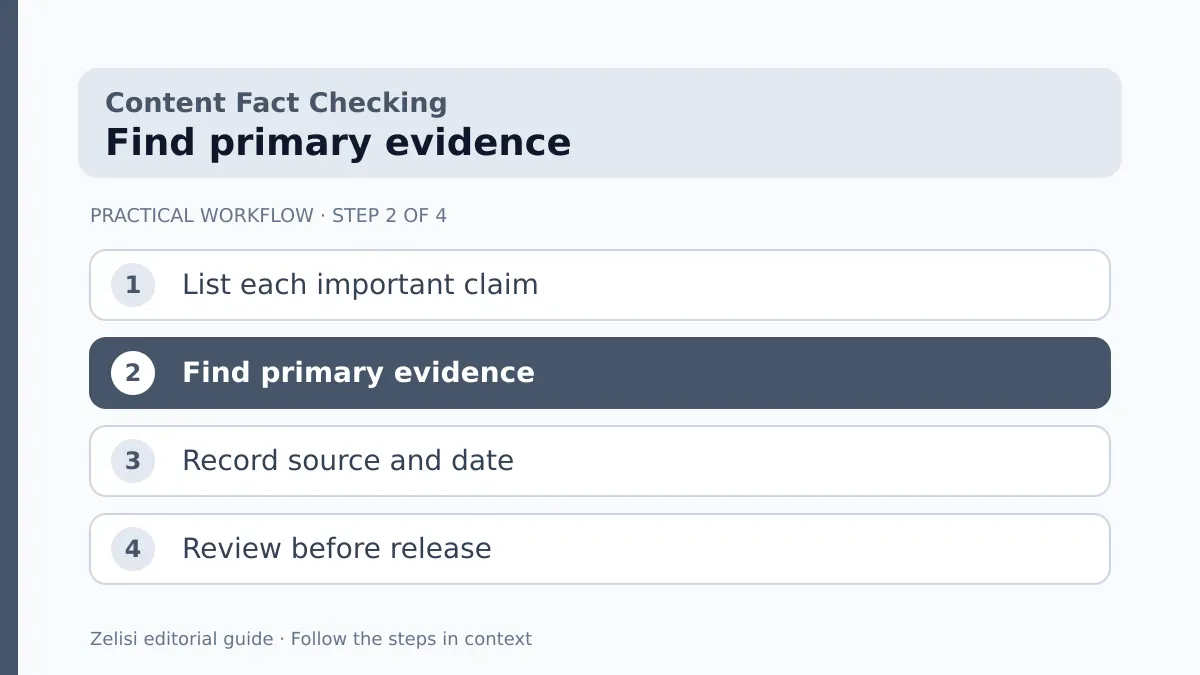
A number may appear on many blogs, yet all those pages may link to the same report. Find that report if it is public. Read the method, sample, region, and period. Ask whether the number describes customers, websites, survey replies, or something else.
Imagine a marketing article that says “70 percent of shoppers do X.” The source turns out to be a poll of 300 users of one app in one country. That does not prove a global behavior. You might rewrite the sentence as a result from that survey, with its clear limits, or choose a better source.
The International Fact-Checking Network’s principles stress source transparency so readers can check significant evidence. A general blog is not a fact-checking newsroom, but the habit still helps.
When an original document is unavailable, say so in your notes. Do not pretend a summary page is primary evidence.
Keep quotes exact and short
A well-known person can add context, but a quote must mean what the speaker meant. Check the original speech, interview, paper, or official page. Read the words before and after the chosen line. A short fragment can change meaning when it is taken out of context.
Do not invent a quote to make a post seem expert-led. If the source gives an idea but not the exact words you need, paraphrase it and attribute the idea. Place the link on the person’s name or the official organization in the sentence where it supports the point.
For a translated source, note whether you are using an official translation or your own paraphrase. Avoid quotation marks around a loose translation. If the claim is important, have someone familiar with the language review it.
Experts can disagree. A fair article may need to describe that difference rather than picking the line that best fits the headline.
Record only the fields you need
An editor should be able to scan the log quickly. A row can include the draft title, claim, source name, source link, publication date, date checked, evidence note, and status. Add an owner when more than one person works on the article.
Use a short status such as verified, needs context, outdated, or remove. The evidence note can say, “Survey of existing customers, not a global sample.” That is more helpful than a green check alone.
- Claim text as it appears in the draft.
- Primary source and the exact page or table.
- Scope: who or what the source measured.
- Checked date and next review date if needed.
- Editorial decision and the person who made it.
The log should help people make a choice, not create more admin work than the article itself. For a short evergreen guide, five carefully checked claims may be enough.
A practical example: a software comparison

Suppose a writer compares two email tools. One vendor page says it offers automation. Another says its free plan has a certain contact limit. The first claim may be broad; the second is a changing product detail.
The editor opens the official plan pages, records the date and region shown, and checks whether the feature is included in the relevant tier. It does not assume that a feature available on an enterprise plan is present on the free plan.
For hands-on claims, the team notes whether it tested the tool. “We opened the signup flow and found three required steps” is a test observation if that work really happened. “The setup takes five minutes” may not be fair without a defined method or sample. If no test took place, the article can say that it reviewed published documentation.
The final article tells readers which parts are based on official feature lists and which parts come from actual use. That helps them judge the comparison.
Handle changing facts with a review date
Some posts age slowly. A guide to writing clear headings may stay useful for years. A guide to an ad platform’s reporting screen may change in months. Give each article a review rhythm based on the kind of claims it holds.
Do not update a visible date without checking the content. A new date does not make old instructions correct. Reopen the source, confirm the steps, retest key links, and note material changes. If a feature has moved, tell the reader where to find it now.
When a source has been replaced, prefer its current official document. Keep a note of the old one if it explains a past result. Do not silently rewrite history in an article about an earlier event.
A small team can maintain a list of posts with fragile facts, such as pricing comparisons or new platform tools. Review those before stable how-to guides.
Separate a source’s finding from your advice
A report may show that a group of people prefers a certain format. It does not prove that every business should use that format. The writer’s advice needs an extra step: explain when the finding could apply and how readers can test it for themselves.
For example, a survey might suggest that customers value fast replies. A helpful article can recommend measuring response time for the business’s own support channel. It should not promise that faster replies will double sales. The first point is evidence. The second would be an unsupported prediction.
Use phrases that match the strength of the data: “the study found,” “the guide recommends,” or “in this example.” Avoid vague phrases such as “research proves” when a study has a narrow sample or a weak design.
Readers deserve a useful next step without a certainty that the evidence cannot support.
Correct mistakes without hiding the change
What the editor should check
If a reader reports an error, thank them and verify it. Check the current source and the copy that was published. If the mistake could change a decision, fix it promptly and add a brief correction note. Keep the note simple: what was wrong, what changed, and when.
A typo may not need a public note. A wrong price, false statistic, or incorrect safety claim often does. Decide on a basic corrections policy before the first complaint arrives, so the response is consistent.
Do not blame a source if the writer misread it. Nor should the team erase a critical comment merely because it is uncomfortable. Moderate abuse, but let factual corrections reach the editor.
The way a site handles mistakes is part of its trust. A clear correction can make readers more confident that the publisher takes accuracy seriously.
A final check that fits a publishing day
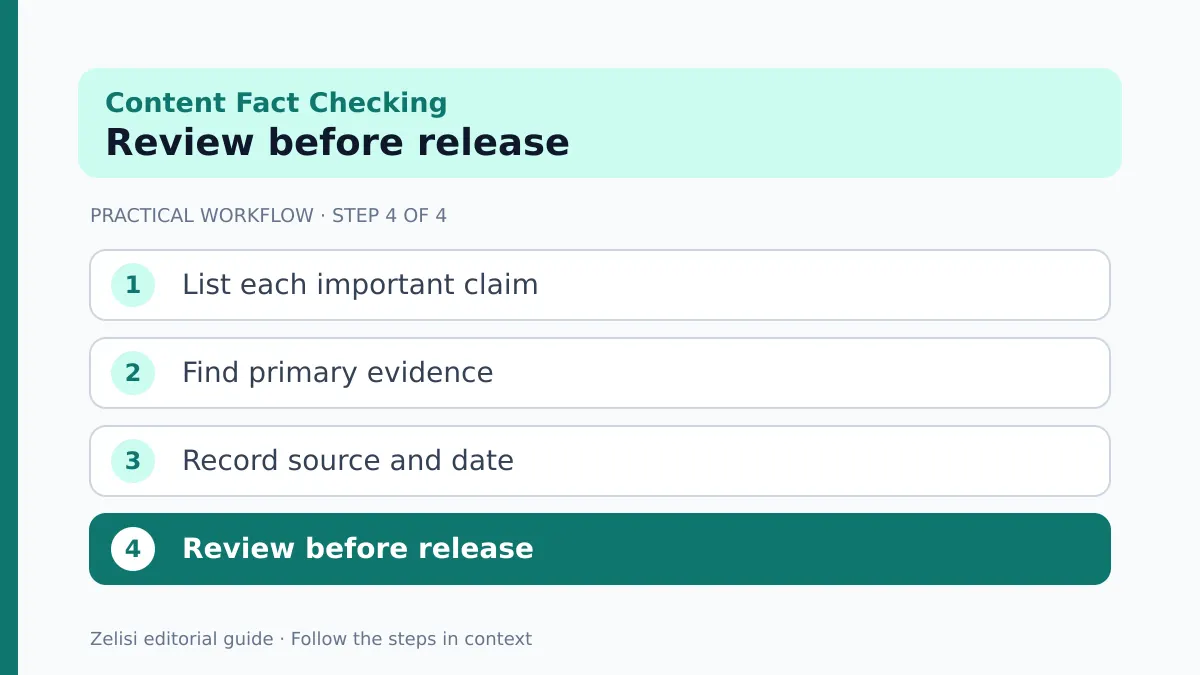
Before publication, ask someone other than the writer to check the highest-risk facts. If the team has one person, return to the draft after a break and review the claim log with fresh eyes. Open the links instead of trusting the headline in a search result.
Check that linked organization names lead to official or reliable pages and that no raw source URL interrupts the article text. Make sure the summary does not overstate the evidence. Check whether an expert quote is both genuine and relevant.
The Google Search Central guidance asks creators to focus on helpful, reliable work for people. A claim log is one practical way to support that goal, but it cannot replace useful reporting or subject knowledge.
Ship the article when the important facts are clear and the reader can act on them. Save the log for the next review.